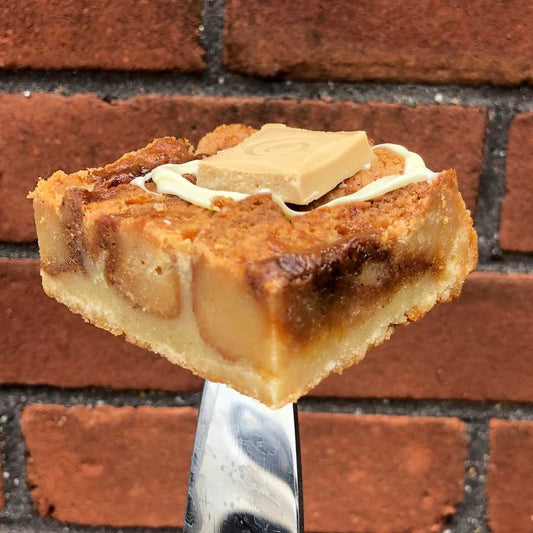

After 23 years of baking brownies, I still enjoy asking one simple question...
"What if?"
Not because I'm trying to make brownies healthier. I'm not. I've always believed that all food is good – it's the frequency and quantity that matter. I'd much rather enjoy one exceptional brownie than a tray of disappointing "healthy" ones.
This experiment had a completely different goal: could I remove eggs, butter and gluten, yet still produce a brownie that someone would choose because it tastes incredible — not simply because it's free-from?
Quick answer: Yes. Using cooked riced potato (for moisture and body), cornflour (for structure) and extra virgin olive oil (for richness) in place of eggs, butter and wheat flour, it's possible to bake a brownie that's fudgy, glossy-topped and doesn't taste "free-from" at all. The full recipe is below.
It started with a problem
I was about to make one of our vegan brownies when I realised I'd run out of gluten-free flour. Most people would have gone to the shops. Instead, after 23 years of baking brownies, my brain immediately asked another question: what job is the gluten-free flour actually doing?
Once you stop thinking about ingredients and start thinking about the job each ingredient performs, baking becomes far more interesting. So instead of reaching for another flour blend, I reached for cooked riced potatoes, cornflour and extra virgin olive oil. An unusual combination perhaps, but every ingredient had a purpose.
What replaces eggs, butter and flour in a brownie — and why
Rather than swapping ingredients like-for-like, I wanted to replace their function. Once you look at a recipe this way, it stops being a list of ingredients and starts being a system:
| Ingredient | Normally replaces | Job it does |
|---|---|---|
| Cooked riced potato | Eggs / flour | Moisture, body and natural starch |
| Cornflour | Wheat flour | Structure once baked |
| Extra virgin olive oil | Butter | Richness, plus its own flavour complexity |
| Hot water | Eggs | Replaces much of the moisture eggs would supply |
| Dark chocolate | – | Richness, and helps the brownie set as it cools |

Blooming the cocoa
One technique I use in several recipes is blooming the cocoa powder. Rather than adding everything together, I mixed the cocoa powder with the sugar, sea salt and hot water first. This serves several purposes:
- It hydrates the cocoa powder
- It dissolves the sugar
- It gives the best possible chance of achieving that glossy, crackly brownie top
Only then did I add the olive oil, vanilla, cooked potato, melted chocolate and finally the cornflour.
The batter changed while it rested
After mixing, I left the batter to rest. Normally people rush straight to the oven. Ten minutes later I tasted it again, and the difference surprised me.
Initially the olive oil was quite noticeable. After resting, the vanilla had become more pronounced and the olive oil had faded into the background, simply making the chocolate taste... more chocolatey. The cornflour had also started hydrating and the mixture already felt smoother.
That alone convinced me that resting this type of batter for 20–30 minutes is worthwhile.
Even the smell was unexpected
Halfway through baking, something unexpected happened. The kitchen didn't smell of brownies — it smelled faintly of fresh focaccia. Warm extra virgin olive oil, potato and Maldon sea salt produced an aroma I'd never associated with brownies before. As the bake continued, the chocolate gradually took over.
A completely different bake
My traditional brownies usually bake at around 150°C for 20–30 minutes. This mixture behaved very differently. With cooked potato, additional water and no eggs, the edges slowly began setting while the centre resembled a hot chocolate pond. Eventually the entire brownie began moving as one soft mass rather than liquid in the middle.
Only then did I increase the oven to 170°C for the final few minutes — a technique I also use with my blondies to encourage a little extra caramelisation and improve the surface.
The Recipe: Vegan, Gluten-Free Potato Brownies
Makes approximately 20 brownies
Ingredients
- 600g dark chocolate
- 500g soft brown sugar
- 450g whole potatoes
- 250g cornflour
- 125g dark full-fat cocoa powder
- 250g extra virgin olive oil
- 200g hot water
- 1 tsp Madagascan vanilla extract
- 8g Maldon sea salt
Method
- Prick the potatoes and microwave them in their skins until completely soft.
- Pass the potato flesh through a potato ricer. Approximately 450g of raw potatoes will produce around 280g of cooked riced potato.
- Mix together the cocoa powder, sugar, sea salt and hot water until smooth, allowing the cocoa to bloom and the sugar to dissolve.
- Stir in the olive oil and vanilla.
- Fold through the warm riced potato.
- Add the melted dark chocolate.
- Finally mix in the cornflour until smooth.
- Allow the batter to rest for 20–30 minutes before baking.
- Bake initially at 150°C until the edges have set and the centre has almost set.
- Increase the oven to 170°C for the final few minutes.
- Allow to cool completely before slicing.
The Verdict
I'll probably experiment with another five minutes in the oven next time. Then again... that isn't really the Brownie Heaven way. I've always preferred someone saying "that's the fudgiest brownie I've ever eaten," rather than "it was baked perfectly but it was a little dry."
The biggest surprise wasn't that the brownies worked. It was what didn't happen. The cornflour never tasted powdery. The potato completely disappeared. The olive oil never dominated. Instead, the brownies developed a flavour that was rich, complex and deeply chocolatey — fudgy in the centre, with just enough chew at the edge to remind you this was still very much a proper brownie.
For a recipe containing no eggs, no butter and no gluten, that's an outcome I'm genuinely delighted with. Not because it's vegan. Not because it's gluten-free. Simply because it's a really good brownie.
Fancy trying one without the baking? Take a look at our Vegan & Gluten Free collection.
Frequently Asked Questions
Can you make brownies without eggs?
Yes. Eggs mainly contribute moisture and help bind the batter. In this recipe, hot water and cooked riced potato take over that job, while dark chocolate helps the brownie set as it cools.
What can replace butter in a brownie recipe?
Extra virgin olive oil works well as a butter replacement. It supplies richness and a different, more complex flavour — though it needs time to rest into the batter so it doesn't dominate.
Can potato really work in a brownie?
Cooked, riced potato provides moisture, body and natural starch — similar to the job flour or eggs would normally do. Done properly, the potato flavour disappears completely into the finished bake.
Do vegan, gluten-free brownies taste different to regular brownies?
They can taste different if the substitutions are treated as like-for-like ingredient swaps. Substituting for function rather than ingredient — as in this recipe — is what gets you back to a genuinely fudgy, chocolatey brownie rather than one that tastes "free-from."
Why rest brownie batter before baking?
Resting allows the cornflour to hydrate and lets strong flavours like olive oil mellow, letting the chocolate and vanilla come forward. In this recipe, 20–30 minutes made a noticeable difference.
Final Thoughts
One of the things I've learned over the last 23 years is that baking isn't about memorising recipes. It's about understanding why ingredients behave as they do. Eggs aren't just eggs. Butter isn't just butter. Flour isn't just flour. Each ingredient performs a job — once you understand those jobs, you stop copying recipes and start creating them.
That's what keeps baking exciting after more than two decades. And who knows — running out of gluten-free flour might just have helped me create one of the most interesting brownie recipes I've ever developed.
Have you ever replaced an ingredient with something completely unexpected? I'd love to hear what worked — or what went spectacularly wrong — in the comments below.
About the Author
Jason Rowe is the founder of Brownie Heaven and has been baking brownies commercially since 2003. Every recipe, experiment and happy accident teaches something new — and that's what keeps him coming back to the mixing bowl.